Nearly one year
back, the Government of India in its wisdom thought I measured up to the job
and offered me to found an institution of national repute, representing one of
the most prestigious brands of higher education in the country, in a new state
in Northern India. The abbreviated name of the institution is - the
perpendicular pronoun twice followed by a consonant. The locale was rather bucolic and simplest of
things took long to be done, because the people were tuned to slower pace, and
marched to a slower drummer. For
example, nothing could be procured on a Wednesday. People took their Wednesdays
more seriously than the most orthodox Sephardim Jews took their Sabbath. No
work, no business meant exactly that, and more! I took it in my stride, more a
compulsion than a choice actually. As the first year was drawing near, time
came to request a bigwig to grace the first convocation.
I was getting a bit
tired of sending innumerable letters, faxes and emails to the entire state bureaucracy
seeking support. These letters never, it seemed, reached the addressee. Once a
letter written to the highest elected official of the state was discovered by my
subordinate lying with a Lower Division Clerk. In an act of desperation, I
sought an appointment with the first citizen of India to invite him as the
chief guest for the first convocation. Whether it was Lady Luck or the initials
of the institute or both- an audience was granted with the first citizen of
India.
Being a Mango
person, brought up in dingy by-lane in the capital of a backward state, I had
not met anyone famous in my fifty nine years, either by chance or through any notable
achievement. Entrance to the giant brown stone edifice on Raisina Hill, walking
through its awe inspiring corridors and magnificent rooms was a crowning
achievement. My hands were trembling when accepting the proffered cup of tea by
the impeccably dressed steward. I deliberately refused the steaming spring
roll, not sure I’d be able to tackle it with the cutlery with adequate deftness
or decorum. Then came the moment of truth- meeting the First Citizen of India,
the Commander-in-Chief of Indian Armed Forces!
My knees were
beating a staccato beat against each other, like a flamenco dancer’s heels
accompanied by castanets. Butterflies in the stomach are a gross understatement,
pterodactyls is probably more apt! I folded my hands in a namaskar to which the First Citizen responded and not only that, he
stood up and extended his hand to shake hands with a mango person! For the next
twenty eight minutes exactly, the First
Citizen read through our institute’s brochure, discussed what problems I faced
in running the institute, asked incisive questions about recruiting of faculty, getting companies to the remote
location to recruit our students and many others, including where I had worked
before taking over this job. Presto, we had a common bond! His elder son and I
had worked for the same large public sector company and I was three years
senior to his son. As I had left the industry to take up teaching in another
institute, again with two perpendicular pronouns, followed by a different
consonant, his son too had left the industry and joined politics.
Two days later, I
get a phone call from the largest building in Lutyen’s Delhi informing me that
the first citizen had agreed to grace the convocation on a date exactly one
month from that day! The dream had come true!
And the nightmare
began! Protocol demanded the request again be routed through gubernatorial
office and the office of the highest elected of the state, while keeping the
district administration in the loop. When this was complied with, the youngish civil
servant actually demanded that the process be restarted, with a document
prepared afresh according to his guidelines and that was to be sent to the titular
head of the state and then on to the First Citizen’s office. The request having
gone twice, starting from opposite ends of the chain, I kept on wondering
whether these twins ever crossed their path. What came back had no resemblance
to either!
Thus, having
established that the Honourable Citizen No.1, no longer “His Excellency” by
official decree, was indeed visiting this institute in this small town in the
boondocks, the next step was to fix the venue. The bureaucracy was bent upon
foisting a rundown, decrepit auditorium owned by one state government
department, situated a kilometre away from the institute. The expectation was
very simple in its essence. “We loan you this auditorium for one day, you pay
for the entire renovation which is to be done by a sister organization, at
rates fixed by us and you return the auditorium day after the convocation”.
Adding insult to injury was the fact that this auditorium had been given to us
on paper but never actually handed over. To top it all, the letter regarding
use of this grand auditorium came from the concerned Commissioner, one day
before the event! He must have commiserated with our problem and then got down
to this act of supreme charity. This decrepit building, with a fine albeit crumbling
facade, mildewed seats, rotten wooden paneling, a wooden stage that had
collapsed and a broken down air-conditioning plant, was inspected by a host of officials of the
state administration, their immediate retinue and innumerable camp followers
and pronounced suitable. Immediately, their counterpart in the police cordoned
off an area up to forty feet away from the stage, spanning the first eight or
so musty rows of seats.
Mystified, I
enquired about this cordon. “This is the D!” “What dee?” I asked, totally
clueless. He said, “But surely, the security D, as given in THE BLUE BOOK”. And
he proceeded to display a brownish, tattered, dog-eared collection of papers,
that was not only not blue but also did not resemble any book, at all. They
were old pages kept together by the sheer weight of history and must have been formulated
around the times of the Anglo-Gurkha War and designed to keep Lord Moira at a
safe distance from any belligerent local
with a kukri, visiting his durbar or camp during his disastrous campaigns in
this state in circa 1800. This government functionary was a rapt student of apt
history. Has it not been said, “Those who do not read history are condemned to
repeat it”? And there I was, trying to explain the not so subtle difference
between a public meeting and a convocation, to a person who after all, had
cleared the highest examination for entry to the bureaucracy and was
responsible for a tract of land 3000 square km and roughly the size of the
country of Guinea-Bissau, with nearly 1.7 million people in his domain, which was
virtually his fiefdom!
The ludicrous
proposal of paying rupees fifteen lakhs for one day for a decrepit auditorium,
where half the seats were unusable and a quarter was to be cordoned off, was
far from appealing. A perky subordinate of mine chirped, “But why are we
calling the Citizen No.1 at all- to see this town or our institute? We should just
say that space is inadequate and entirely too small for the Citizen No.1 and
stick to our guns”. Armed with this brilliant one-liner, I approached the
mini-suzerain and blurted out the same. And presto, he agreed!
So it was agreed
that the convocation would be held in a field adjoining the institute’s
temporary campus.
What took the cake
was the issue of rendition of the National Anthem. A choir of children from a
local school was requested to sing the National Anthem. During practice, the
plenipotentiary from the police again took out his version of the ‘blue book’
and pointed out a relevant passage which talked of the anthem being either sung
or played by a band and blah blah. The plenipotentiary pointed out that since
the anthem was being ‘sung’, no instruments could be allowed! Flabbergasted and
totally at a loss for word by the turn of semantics, I agreed with due deference!
However, on the day of the event I managed to smuggle in a harmonium and a pair
of tablas.
There were many
such close encounters with the state bureaucracy during the one month of
preparations for our convocation, and documenting all of them would result in a
tome, which was beyond my literary capacity. These encounters left me decidedly
older but none the wiser. I often sit down, reflect and ponder on how this
great country of ours is moving at all! There must be a Supreme Being, clearly
aware of all these machinations, and steering this country forward despite the
bureaucracy!
 A
bike trip was long overdue, as I had made the last trip with the PGP 2015-17
batch in November 2015. The new batch of 2016-18 were actually complaining that
they had not yet gone on a bike trip with me. So with the planning and
logistics and the mandatory lecture on
driving guidelines (25 metres apart, no overtaking, no speeding, formation
driving, hill driving etiquette etc.) delegated to Rizwan of the senior batch,
a veteran of many trips, we included quite a few enthusiasts from the new batch
too.
A
bike trip was long overdue, as I had made the last trip with the PGP 2015-17
batch in November 2015. The new batch of 2016-18 were actually complaining that
they had not yet gone on a bike trip with me. So with the planning and
logistics and the mandatory lecture on
driving guidelines (25 metres apart, no overtaking, no speeding, formation
driving, hill driving etiquette etc.) delegated to Rizwan of the senior batch,
a veteran of many trips, we included quite a few enthusiasts from the new batch
too. As usual, the inter-campus
coordination and cold mornings caused a delay in starting. We started at nearly
8 am, instead of the planned 6.30am on Saturday January 21, 2017 with 8 bikes
and 14 riders and pillion for the 170 odd km trip one way. The plan was to
reach Mukteshwar by late afternoon covering about 170 km and the route was
Kashipur-Ramnagar-Kaladhungi-Haldwani-Bhimtal-Bhowali-Mukteshwar. The bike
count was: four Bullet Classic 350, one Thunderbird 350, one Bajaj Pulsar 200,
one KTM 200, one Yamaha FZ 150.
As usual, the inter-campus
coordination and cold mornings caused a delay in starting. We started at nearly
8 am, instead of the planned 6.30am on Saturday January 21, 2017 with 8 bikes
and 14 riders and pillion for the 170 odd km trip one way. The plan was to
reach Mukteshwar by late afternoon covering about 170 km and the route was
Kashipur-Ramnagar-Kaladhungi-Haldwani-Bhimtal-Bhowali-Mukteshwar. The bike
count was: four Bullet Classic 350, one Thunderbird 350, one Bajaj Pulsar 200,
one KTM 200, one Yamaha FZ 150. As we hit the Ramnagar highway we
encountered very dense fog which dogged us over the entire stretch of more than
25km. The trucks whizzing past in near zero visibility was scary. The ride from
Ramnagar to Kaladhungi was under a bright and clear sky. Breakfast at
Kaladhungi, opposite Jim Corbett Museum was sumptuous- stuffed paranthas and
hot tea. The onward journey from Kaladhungi to Bhimtal was pleasant, except for
crossing Haldwani. From Bhimtal we proceeded to Bhowali, with a couple of stops
to regroup especially on forks on the road where Google maps was of not much
help! On the way we saw parasailers gliding down from the hills around Bhimtal.
As we hit the Ramnagar highway we
encountered very dense fog which dogged us over the entire stretch of more than
25km. The trucks whizzing past in near zero visibility was scary. The ride from
Ramnagar to Kaladhungi was under a bright and clear sky. Breakfast at
Kaladhungi, opposite Jim Corbett Museum was sumptuous- stuffed paranthas and
hot tea. The onward journey from Kaladhungi to Bhimtal was pleasant, except for
crossing Haldwani. From Bhimtal we proceeded to Bhowali, with a couple of stops
to regroup especially on forks on the road where Google maps was of not much
help! On the way we saw parasailers gliding down from the hills around Bhimtal. 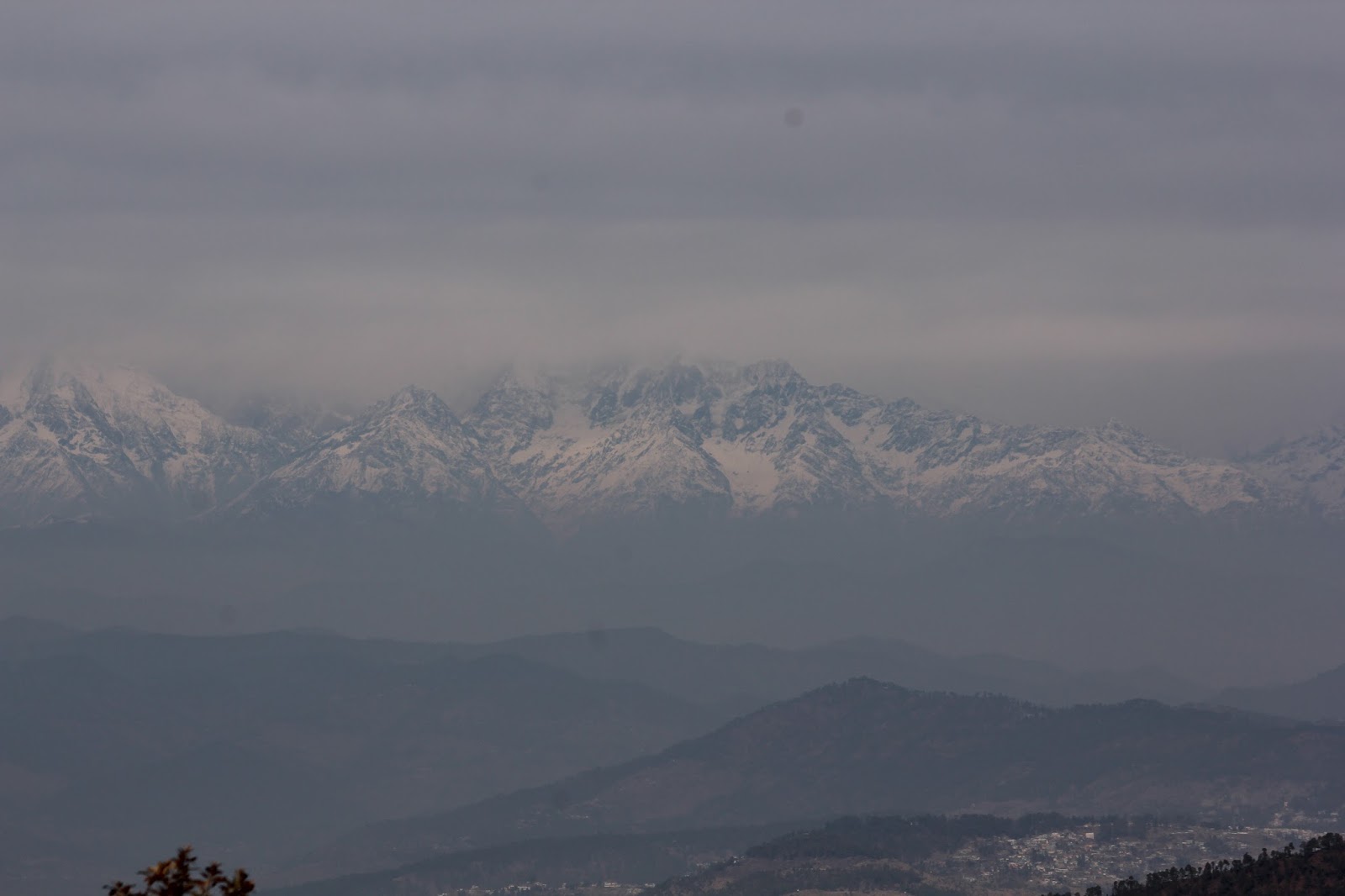 At
Ramgarh we experienced patches of ice on the road from snow fall earlier that
week, not much though. Snow on the hillsides at Ramgarh gave our students
enough photo-ops, as did all the stops. As we were approaching Mukteshwar,
problems surfaced. The clutch of the Pulsar failed and the FZ refused to start.
Three hours were spent in trying to repair both, including trips up and down to
Mukteshwar to catch an elusive mechanic. The Pulsar was parked with a friendly ship-owner
and the FZ started reluctantly.
At
Ramgarh we experienced patches of ice on the road from snow fall earlier that
week, not much though. Snow on the hillsides at Ramgarh gave our students
enough photo-ops, as did all the stops. As we were approaching Mukteshwar,
problems surfaced. The clutch of the Pulsar failed and the FZ refused to start.
Three hours were spent in trying to repair both, including trips up and down to
Mukteshwar to catch an elusive mechanic. The Pulsar was parked with a friendly ship-owner
and the FZ started reluctantly.
 The morning of January 22 started
late, each complaining of aches etc. and post-breakfast
long planning session involved of what to do with the two immobile bikes.
The morning of January 22 started
late, each complaining of aches etc. and post-breakfast
long planning session involved of what to do with the two immobile bikes. The food was good but the rooms were chilly and the stiff, chilly breeze did not help.ning of aches etc. and post-breakfast long planning session
involved of what to do with the two immobile bikes. Another hour went in
getting a replacement plug for the FZ, but it could not possibly make the trip
back because it was burning engine oil due to worn out rings. Finally the sick
bikes were put on a small truck for onward trip to Haldwani for repairs at
respective dealers. Six remaining bikes separated in to two groups, one group
of two heading back to Kashipur and the other group of four decided to try for
paragliding near Bhimtal and return via Naintal.
The food was good but the rooms were chilly and the stiff, chilly breeze did not help.ning of aches etc. and post-breakfast long planning session
involved of what to do with the two immobile bikes. Another hour went in
getting a replacement plug for the FZ, but it could not possibly make the trip
back because it was burning engine oil due to worn out rings. Finally the sick
bikes were put on a small truck for onward trip to Haldwani for repairs at
respective dealers. Six remaining bikes separated in to two groups, one group
of two heading back to Kashipur and the other group of four decided to try for
paragliding near Bhimtal and return via Naintal.  The
return trip, with me taking on Chauhan (PGP 2016-18) as a pillion and Swagat on
his Thunderbird with a pillion. The return journey wasn’t without incident! A
car overtook us somewhere near Baelparao and one of the passengers frantically
waved us to stop. He told us they had seen one bag falling off the Thunderbird
and had been trying to warn us. Thanks to the warning message, the bag was
found. Retrieval took more than half an hour and gave us the opportunity for a
cup of tea. The journey ended around 5pm on Sunday January 22, 2017 with around
350km on the odometer. We have started planning for the next trip in March
2017.
The
return trip, with me taking on Chauhan (PGP 2016-18) as a pillion and Swagat on
his Thunderbird with a pillion. The return journey wasn’t without incident! A
car overtook us somewhere near Baelparao and one of the passengers frantically
waved us to stop. He told us they had seen one bag falling off the Thunderbird
and had been trying to warn us. Thanks to the warning message, the bag was
found. Retrieval took more than half an hour and gave us the opportunity for a
cup of tea. The journey ended around 5pm on Sunday January 22, 2017 with around
350km on the odometer. We have started planning for the next trip in March
2017. 


